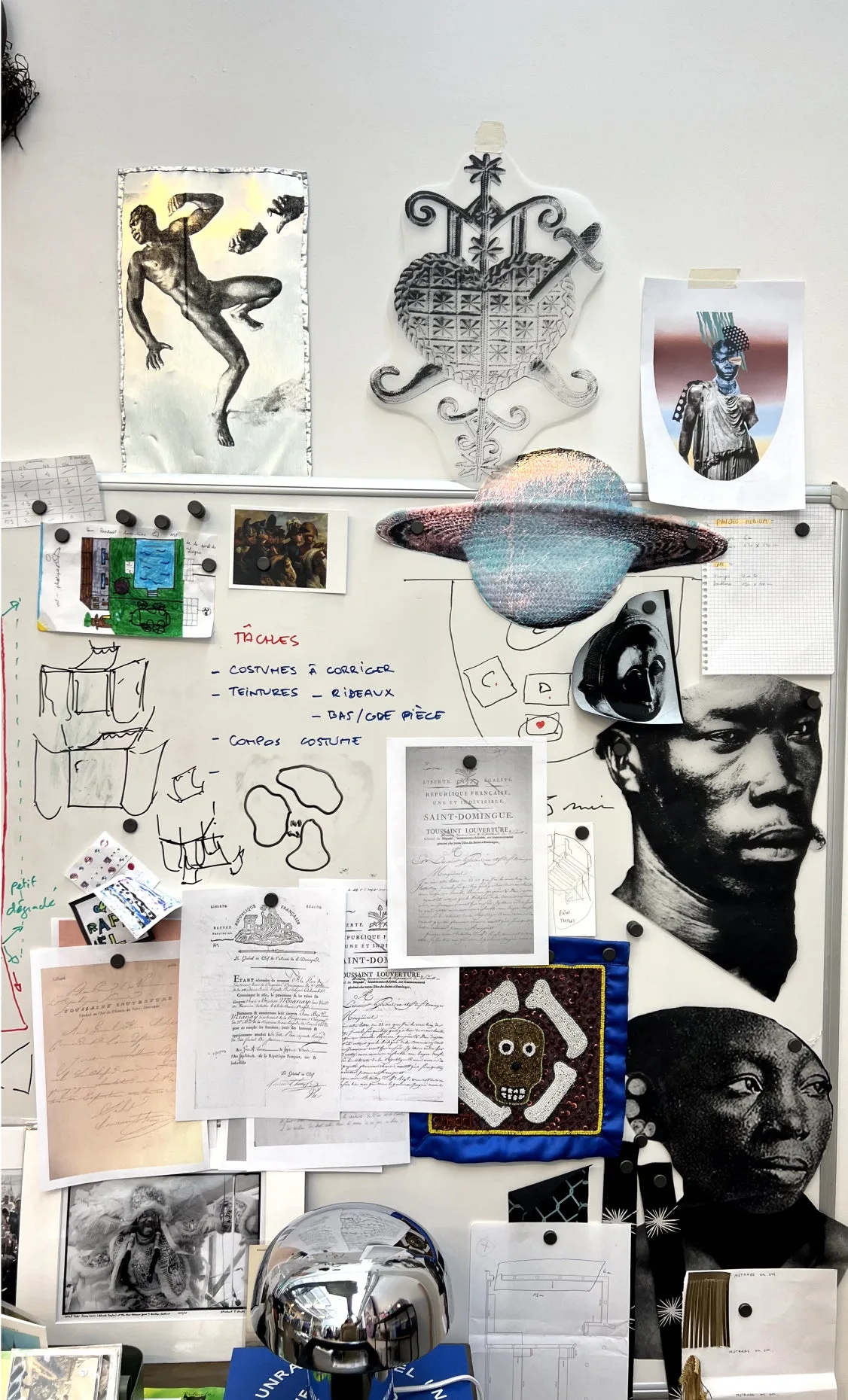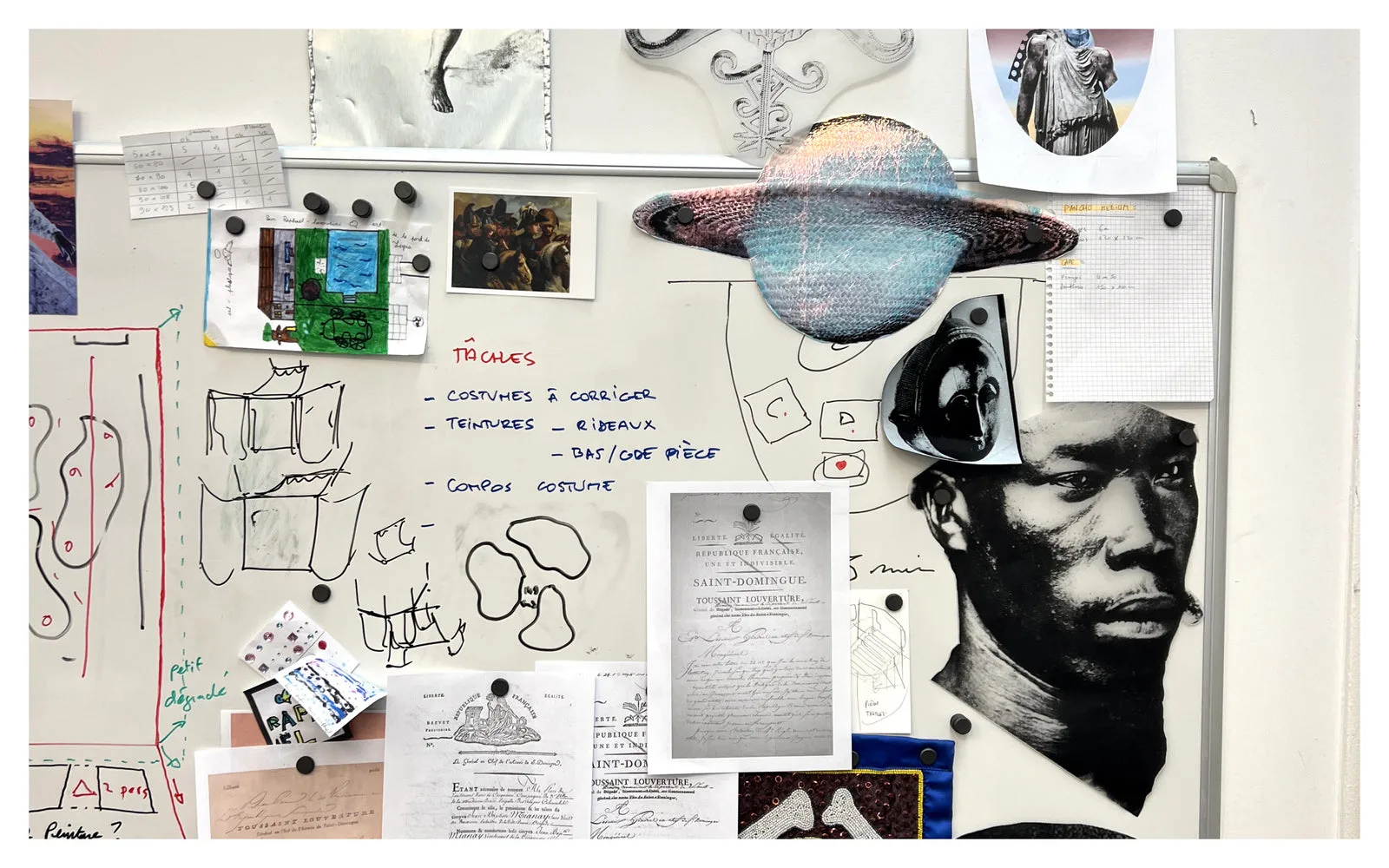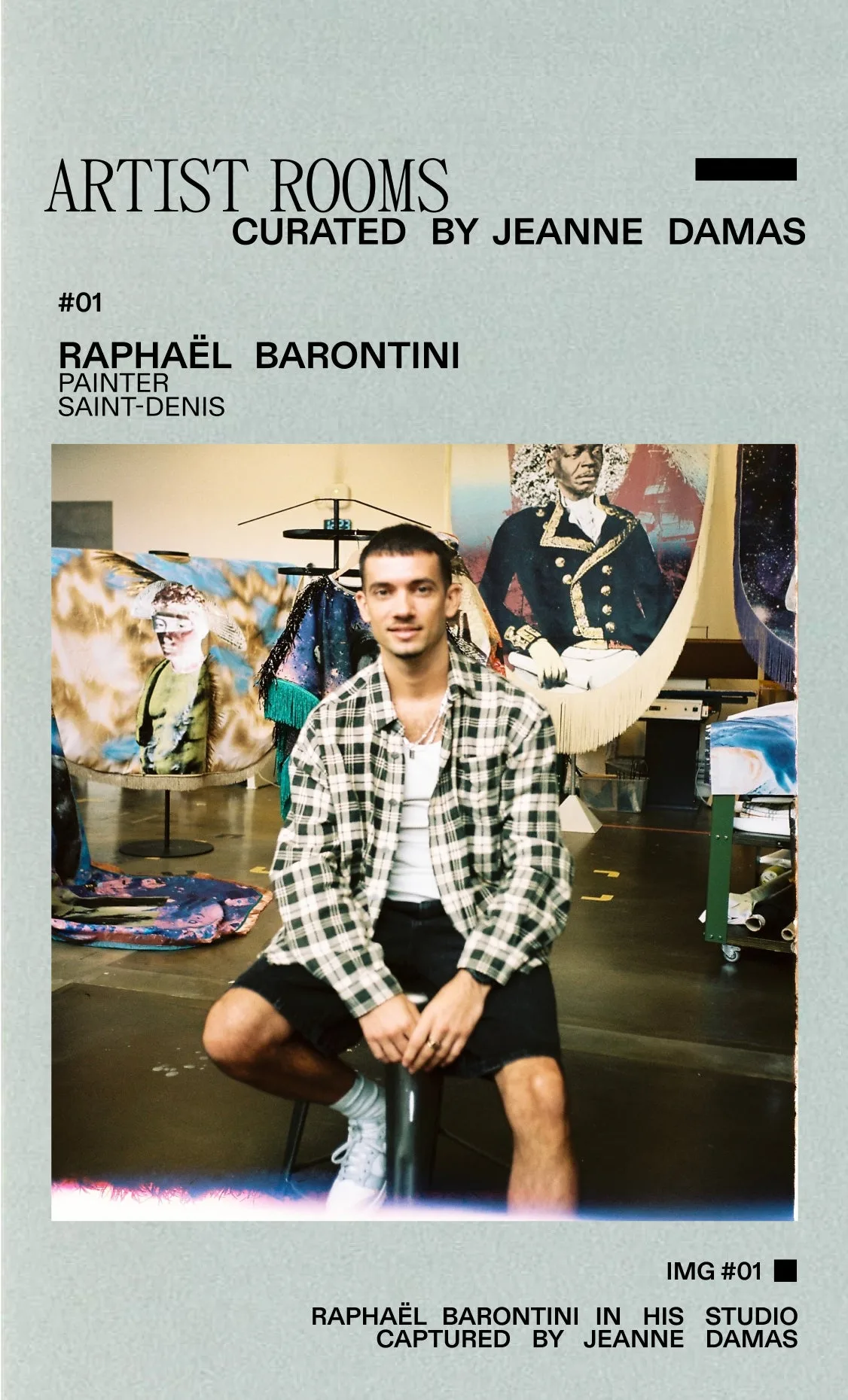
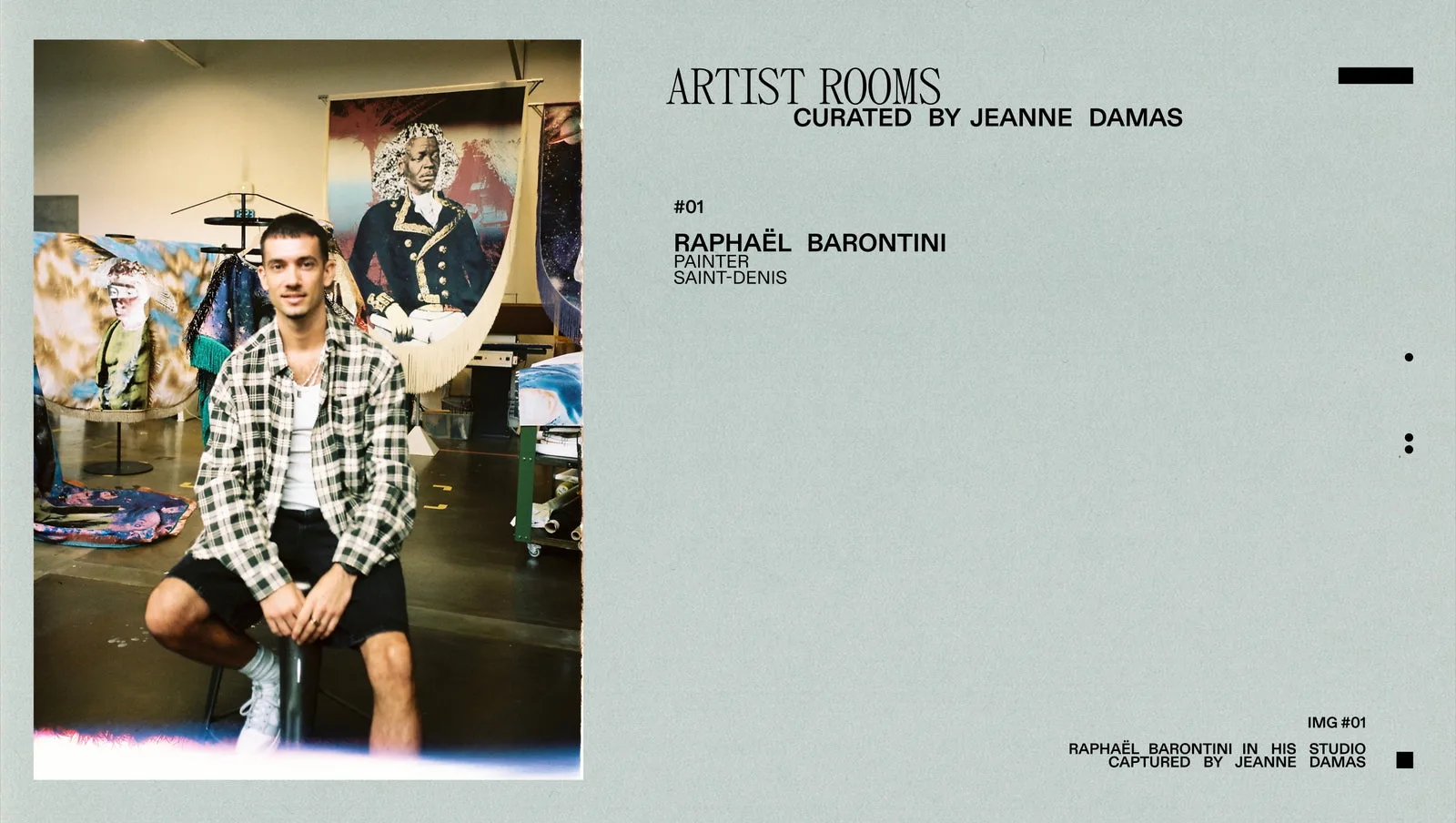
Discover with Jeanne Damas the work of the multidisciplinary French artist Raphaël Barontini in his workshop in Saint-Denis. Raphaël recently took over the Pantheon with an installation commemorating the heroes of the abolition of slavery and is currently working on his next exhibition at the Palais de Tokyo.
INTERVIEW
JD: I read that you started with music. What then brought you to painting? Was art already present in your family?
RB: Yes, I think I was lucky because both my parents were very culturally open, they read a lot, they listened to music and this atmosphere undoubtedly opened my mind and encouraged me to study the arts. I grew up in Saint-Denis, in the city, where being an artist is not necessarily the first idea that comes to mind when you think about your studies.
JD: Afterwards, what does it mean to be an artist?
RB: Exactly, at first I was more interested in music, I played percussion and I played in a carnival group. At the time I didn’t really imagine what an artistic career was.
JD: Your father is a musician, right?
RB: He was a high school teacher and played music on the side. Music was his passion and he created a festival called “Winter Sounds”, which he directed for 25 years. So music was very present in my life. I went to concerts, I was backstage from a very young age, it also gave me the idea of having a potential artistic career. The switch happened in high school, where a teacher advised me to try to get into an art school. I kind of thought maybe I was going to be a teacher, I loved history, but I didn't really think a career as an artist was possible.
“I am interested in the history of painting, the history of representation. This is the reason why there are so many figures and portraits in my work: for all that it means historically.”
Raphaël BARONTINI
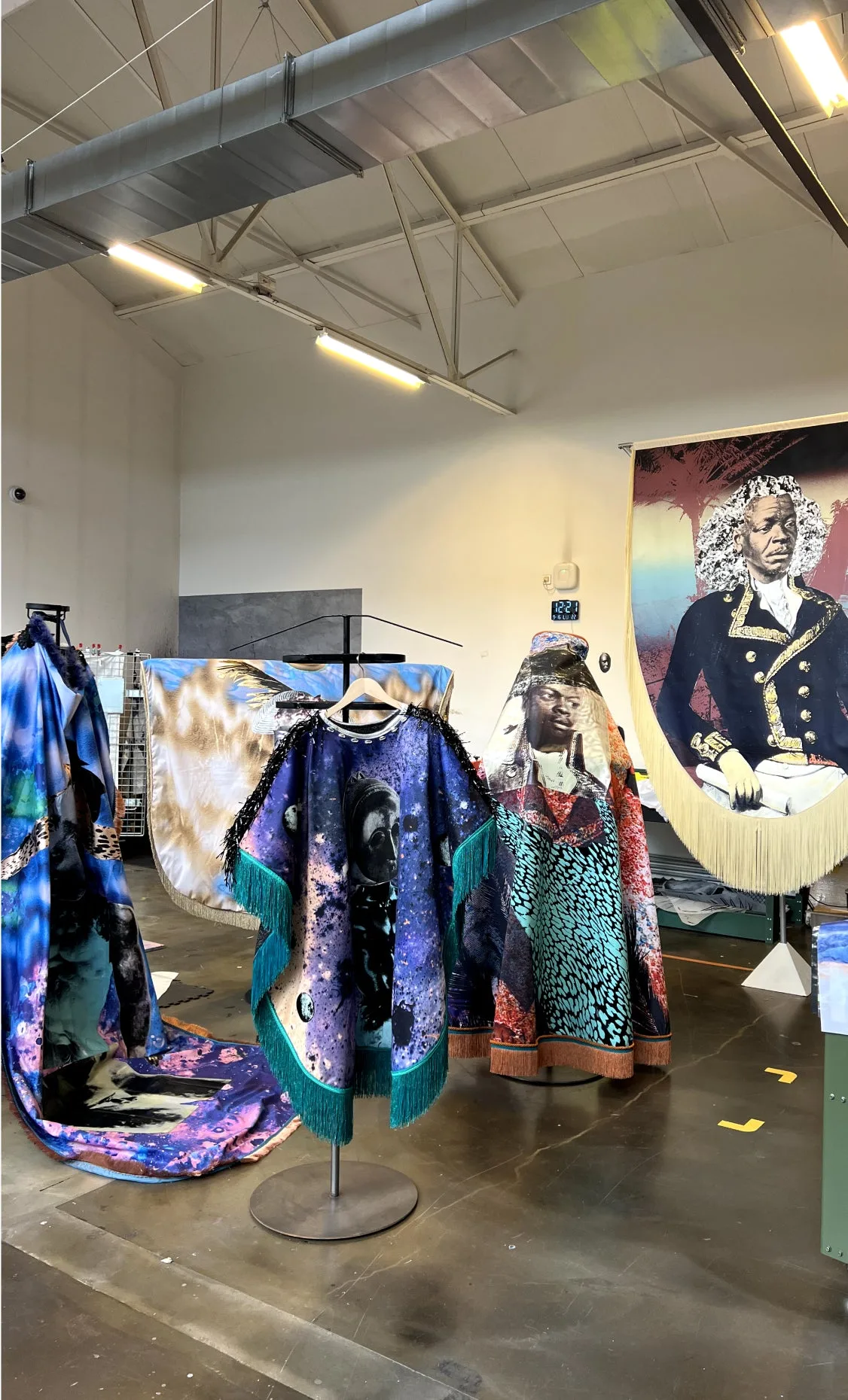
IMG #02
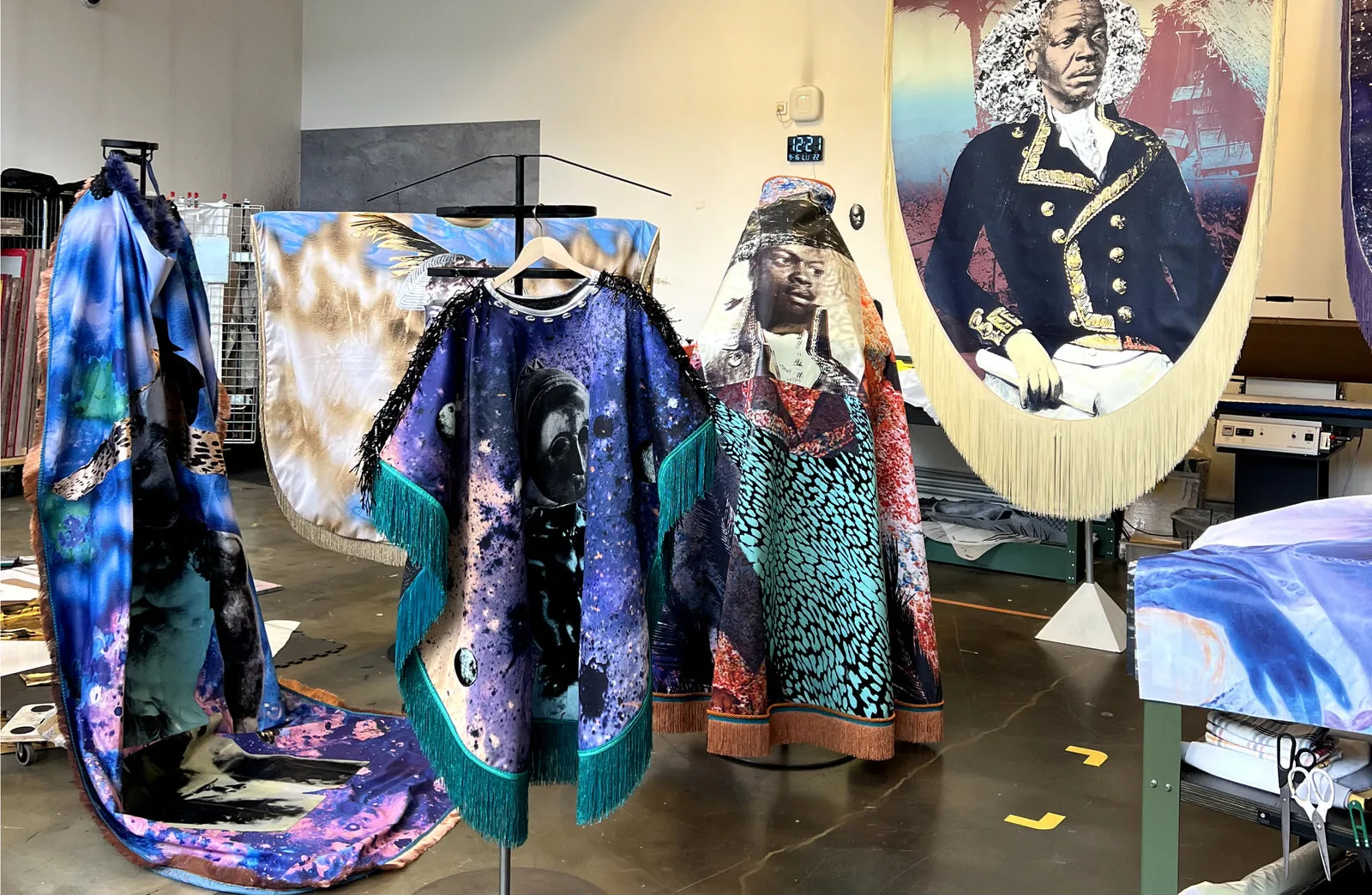
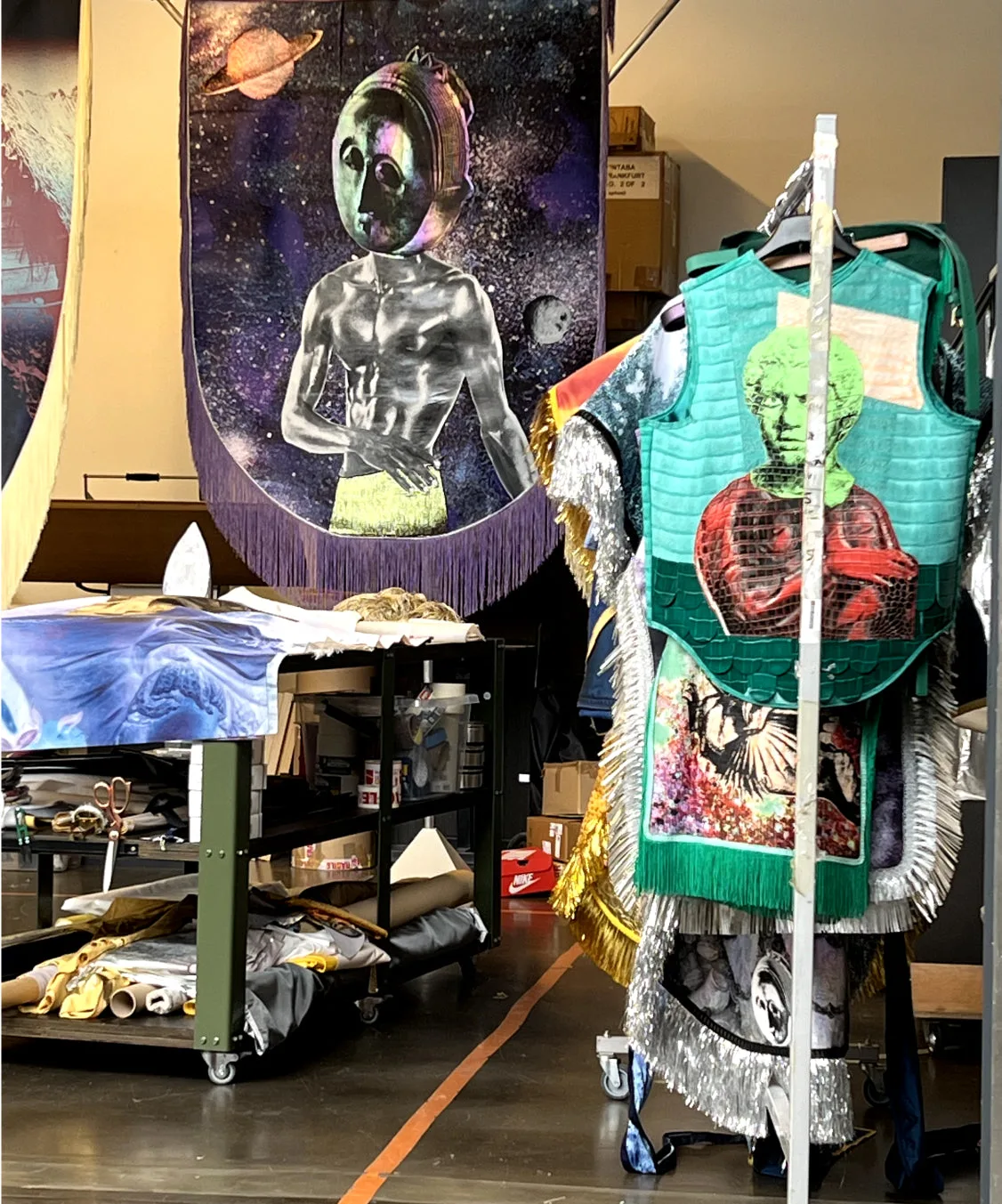
View of the workshop
Cloak Toussaint Bréda Printing
screen-printed and digital on fabrics
and Banner Louis Delgrès painting
acrylic and screen printing on canvas 240 x 165 cm
IMG #03
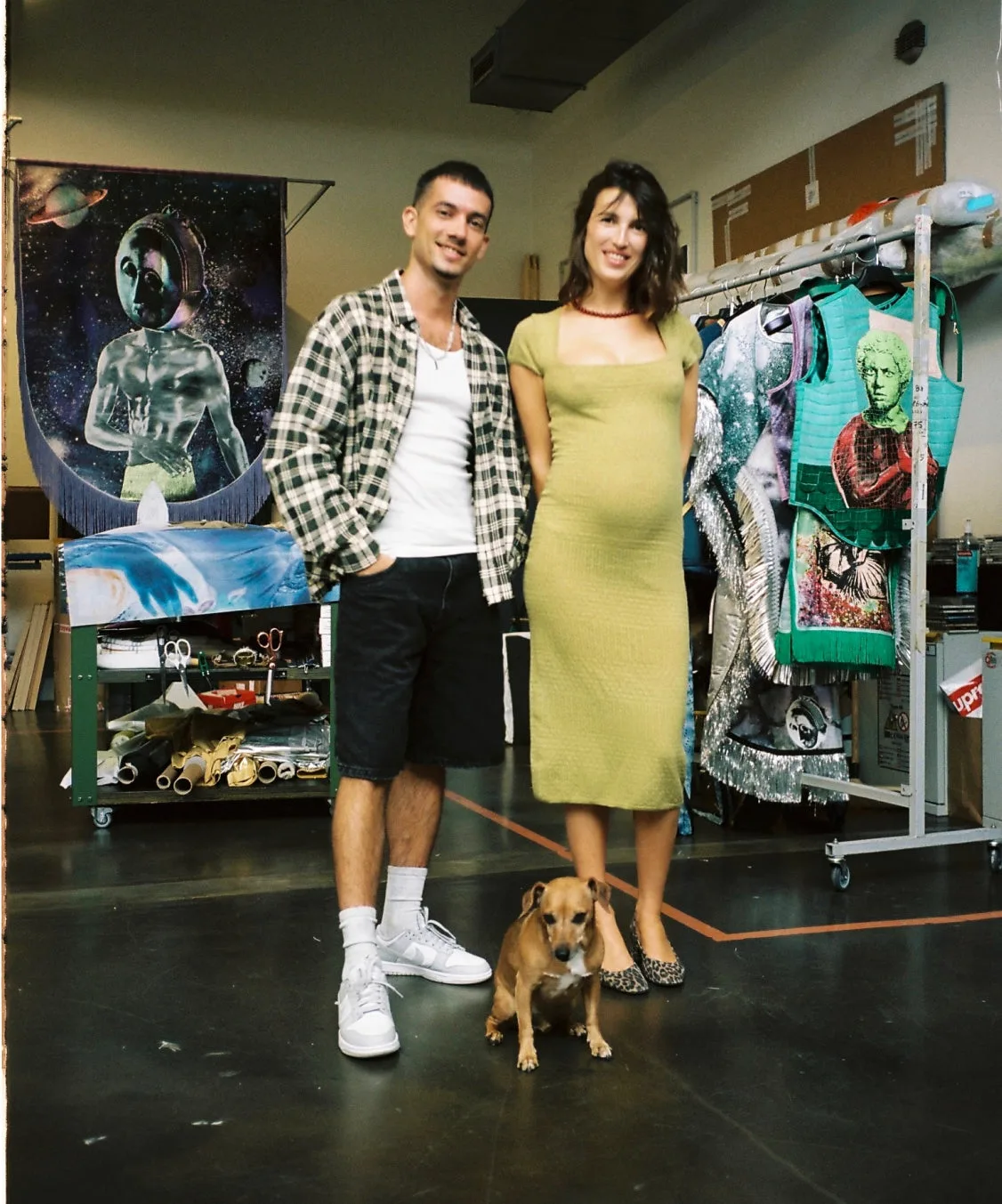
Raphaël Barontini with Jeanne Damas
and Dobby in the artist's studio
JD: It’s great to cross paths with such encouraging teachers. How are specializations in Fine Arts created? Do you study lots of different disciplines, sculpture, drawing etc, or do you choose an art form from the start?
RB: The Beaux-Arts of Paris operate quite uniquely. There are approximately 25 workshops led by professional artists. The choices are made according to the sensitivity of each person, who goes towards a particular teacher or that artist. For my part, I really had the DNA of a painter, I loved printing techniques and in particular screen printing which I had been practicing for a long time. I knew very quickly that I wanted to be in a painter’s studio.
JD: Yet we don’t immediately think about painting
when we see your work.
RB: Yes because it is very multidisciplinary. Originally, I was interested in the history of painting, the history of representation. This is the reason why there are so many figures and portraits in my work: for all that it means historically.
JD: How did this project for the Pantheon come to you?
RB: Several years ago, I had started a series of portraits which included Caribbean figures who were relatively unknown in France, in France, and who had fought against slavery. There were also mixed-race personalities who had had a life and a certain recognition here in Paris in the 18th century. They ranged from the Chevalier Saint-Georges, a great composer, but also a swordsman, and harpsichord teacher to Marie-Antoinette, to Guillaume Guillon de Léthière, a great painter who remains little-known today. These are often profiles with a European father, planter or high-ranking official from France to the West Indies. They could be led to study military or artistic studies in Paris. My idea was to revive these figures.
The Center for National Monuments invited me to imagine an exhibition featuring these abolitionist and resistant figures within a monument so symbolic for the History of France, such as the Pantheon.
"When I left the School of Fine Arts, the work became multidisciplinary, I started making textiles in very large formats, a bit like patchwork or collage where screen printing on fabrics, dyes and digital prints mixed together."
Raphaël BARONTINI
JD: A friend who studied Fine Arts told me that the teachers reiterated the importance of a strong message in the work, beyond aesthetics.
RB: For me, it was almost the opposite. Strangely, I felt rather a sort of disinterest in these somewhat political and historical questions when I was at the Beaux-Arts.
JD: Did you want it to come from you?
RB: Yes, that’s it. At the end of my studies in Fine Arts, I spent a year in New York, at Hunter College, where I discovered the scenes of African-American artists, which were shown in museums whereas in France this was less the case at the time. I told myself that I had to continue this trajectory, think about what I wanted to say, to convey. At Fine Arts it was very “painting-painting”, then I had a little shift when I graduated when I also started working on textiles. When I left the School of Fine Arts, the work became multidisciplinary, I started making textiles in very large formats, a bit like patchwork or collage where screen printing on fabrics, dyes and digital prints mixed together.
JD: What type of media do you use? Fabric?
RB: Yes, the base is a digitally printed fabric. This background is a photo of an abstract background that I first paint. Then I glue figurative elements which are screen-printed on vinyl, the shiny side of which I like. As the fabric is very smooth, the prints are quite precise, I iron-on, I sew, there are lots of different techniques applied to each piece.
JD: Did you learn to work with textiles alone or during your studies?
RB: It was really self-taught. I made my first sewing machine moves on a family machine with really crappy seams, which I'm not very proud of anymore. When I find old pieces, I say to myself: “my god, it’s a disaster”. I improved afterwards, especially during covid.
IMG #04
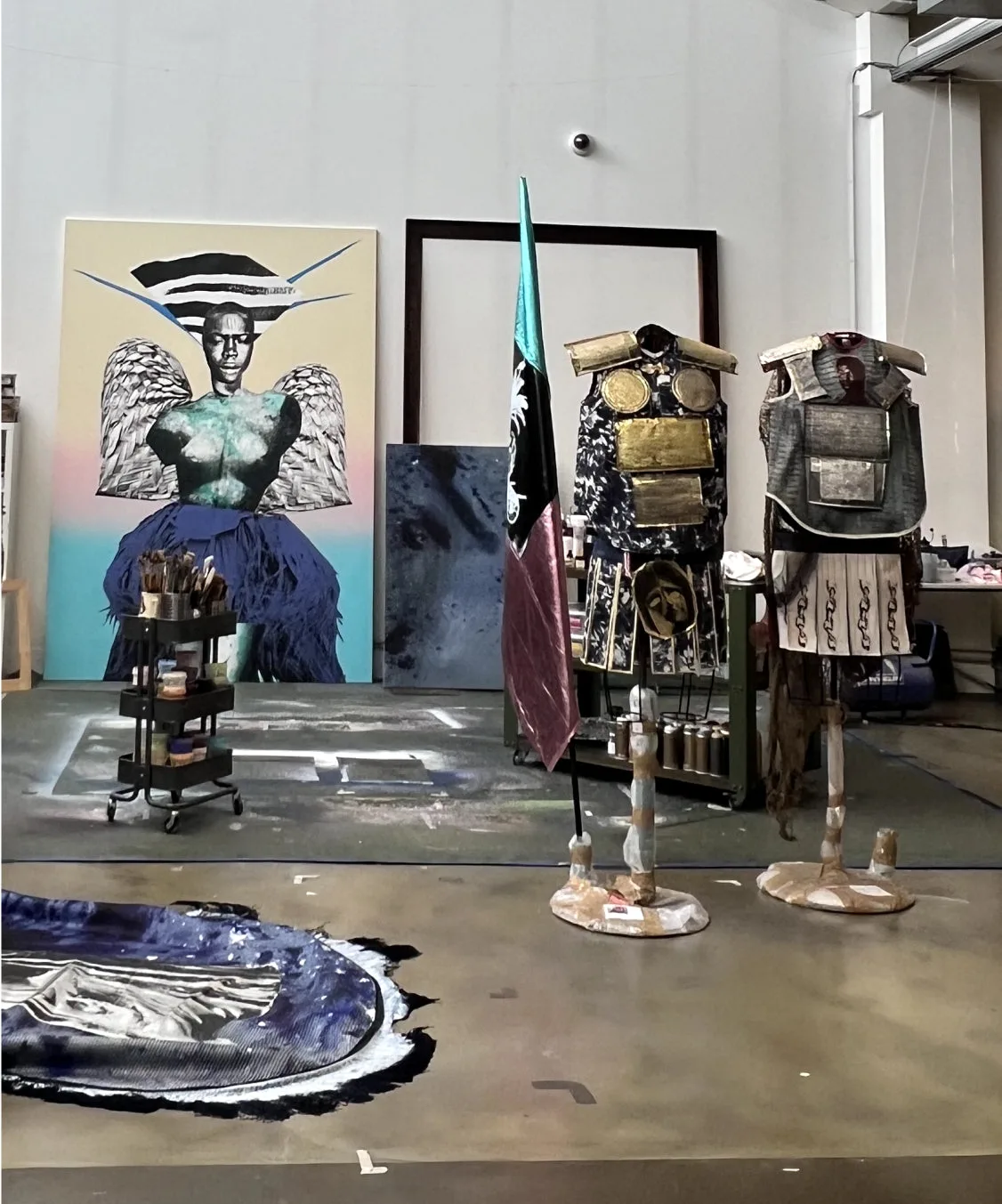
Painting Creole dancer acrylic painting and screen printing on canvas 270 x 190 cm
and leather outfits Black Spartacus
IMG #05
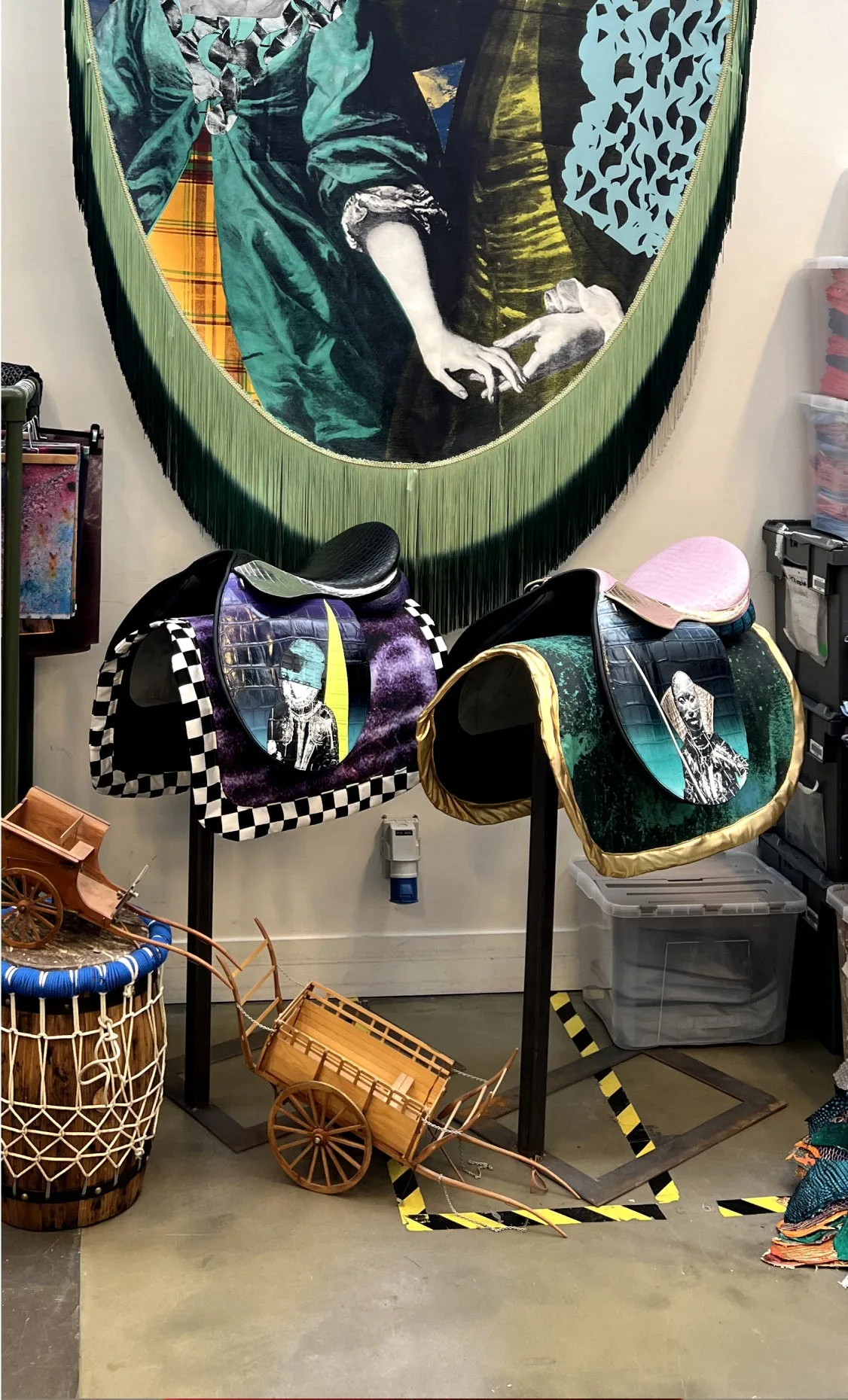
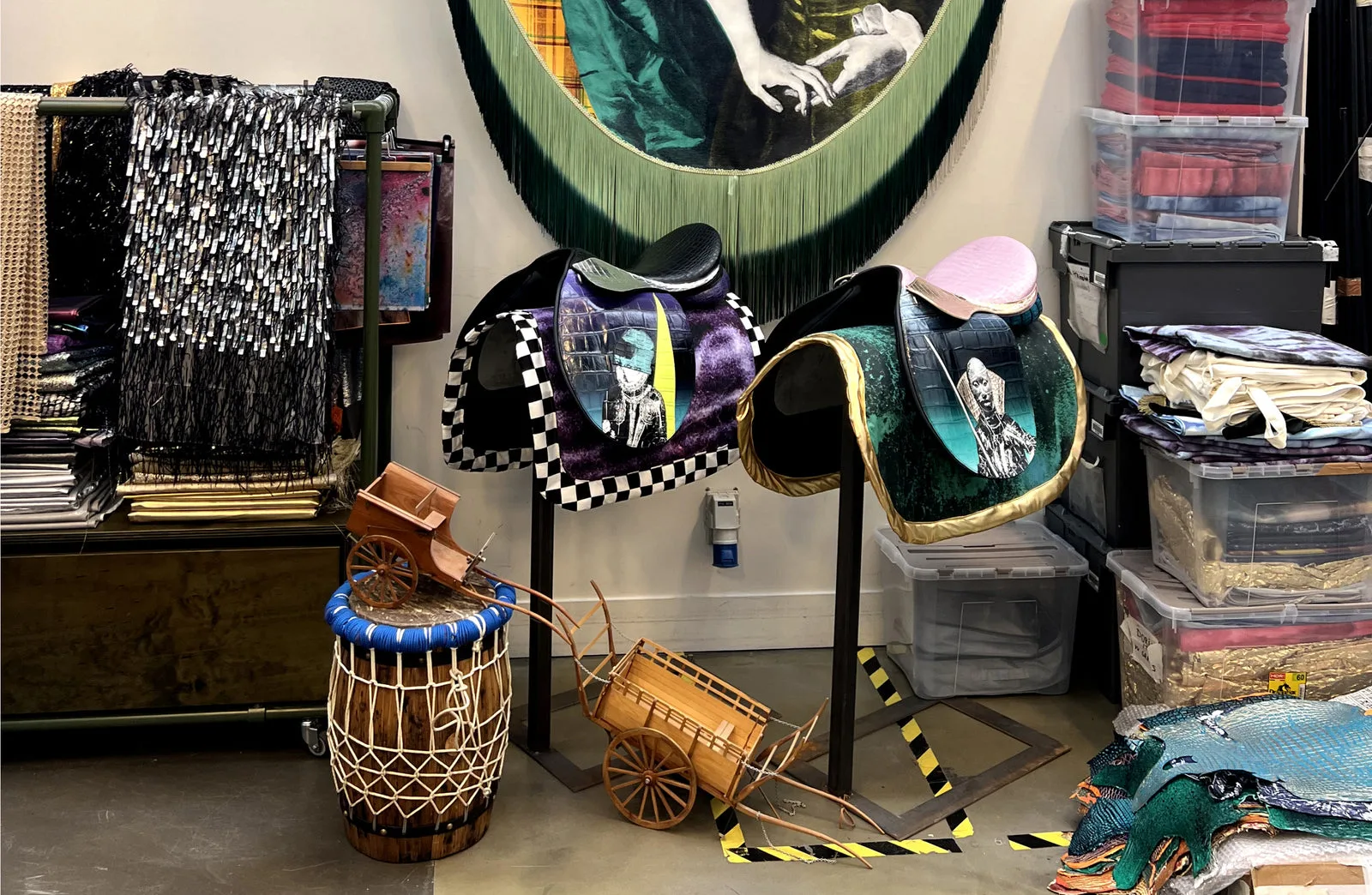
Riding saddle Pegasus I & II
made of crocodile leather
IMG #06
Banner Baoulé Dancer and Allure Saint Maurice
Screen and digital printing on leather and fabrics
JD: How long did it take?
RB: I left school in 2010. It was between 2010 and 2015 that this aspect of my work developed.
JD: So you've been exploring this approach for almost 15 years, it's quite anchored...
RB: Afterwards, there is a second key moment: when I start making wearable parts. I was invited to do a residency with LVMH crafts in Singapore for six months, which ultimately became eight because of Covid. I come across the know-how of the artisans of this company, specialized in leather processing. The artist is invited to create pieces with the methodology and techniques of artisans. It was super interesting, a real dialogue between creators. Being in contact with craftsmen who are used to making accessories through their know-how and also the material quality of the leather directed me towards wearable pieces.
JD: Exactly, seeing all these materials, the textiles you use, I wondered what your relationship was with fashion? You also do parades - does the subject interest you?
RB: That interests me. I don't know, maybe I have an obsession with the human body, its presence. I just find my portable pictorial pieces activated. For example, recently I imagined a performance for La Nuit Blanche in Paris with professional hip-hop dancers and two carnival groups. My studio created 80 costumes.
JD: So good.
RB: It was great to see them live, wake up. I like both, I like when portable pieces become sculptures but I also like when they are in movement, when they come to life.
JD: Was the Pantheon just after the residency?
RB: It was three years later. There was a big design phase. We had to do sketch-ups in 3D, the project was special because in a monument, we could hardly touch anything, hang anything.
JD: They don’t often give carte blanche to the Pantheon?
RB: No, it’s rare. I think it was the third time. JR had done a big installation several years ago. It was a special request from the CMN to imagine a memorial project on the history of the struggles against slavery and its abolition thanks to a contemporary intervention by an artist.
"The idea was to highlight little-known figures in the fight against slavery. I know this story well, I have part of my family who comes from Guadeloupe. I wanted to move the cursors a little by choosing a majority of women - many of them have fought against slavery at different levels."
Raphaël BARONTINI
JD: Can you summarize the message of the exhibition, for those who missed it?
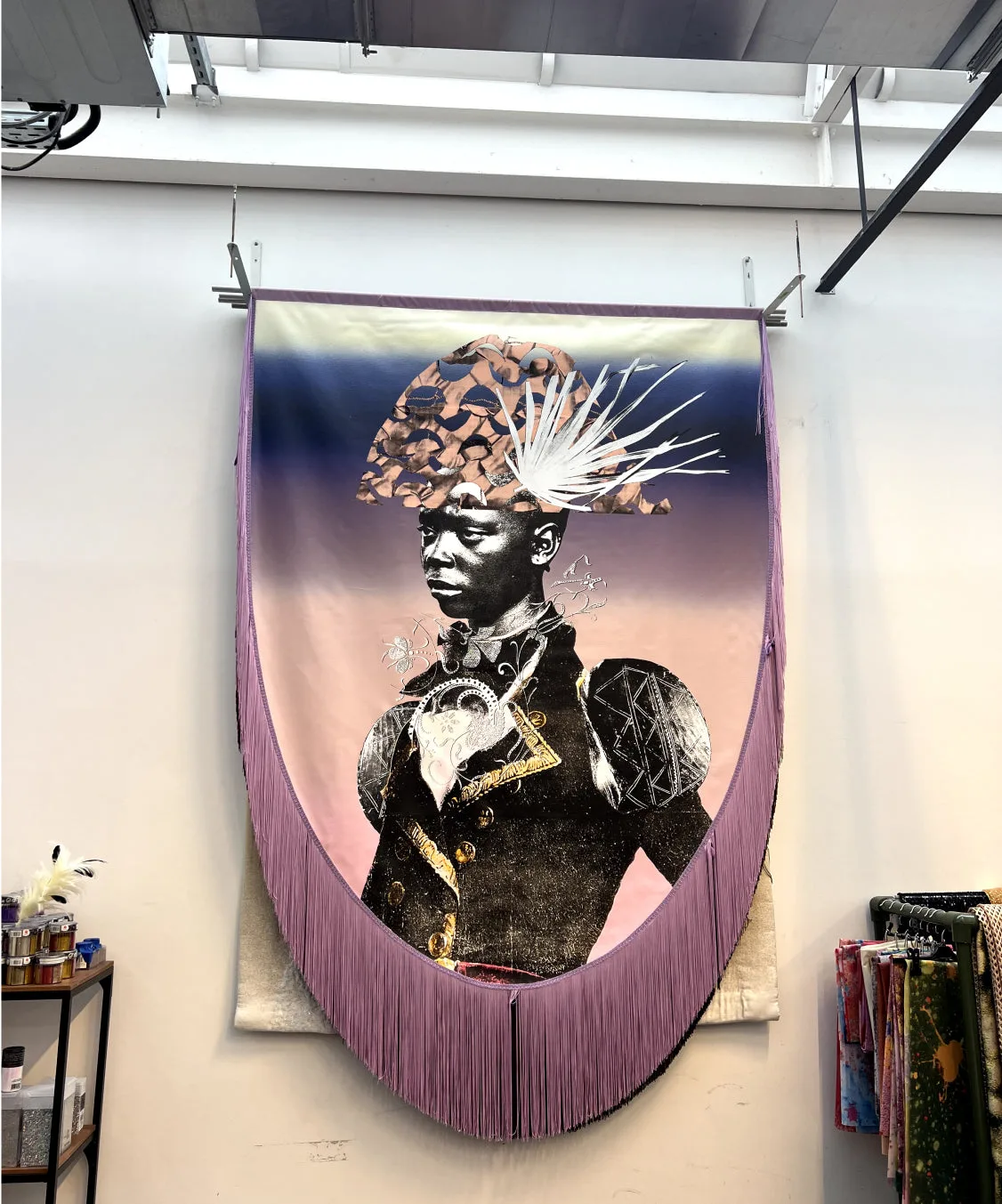
RB: The exhibition was called 'We Could Be Heroes'; the idea was to highlight little-known figures in the fight against slavery. I know this story well, I have part of my family who comes from Guadeloupe and I went to the West Indies a lot when I was younger. In the West Indies, it is a very present, very strong story, and very well known by the West Indians. On the other hand, in France, few people are really aware of what happened. I wanted to move the cursors a little by choosing a majority of women - many of them have fought against slavery at different levels. This is the portrait of Sanite Bélair, one of the rare female officers in the Haitian insurgent army. She is an extremely strong woman.
JD: Are you repainting it from a portrait?
RB: Yes, my painting work, all my compositions, whether in textile pieces, in paintings, in banners, comes from the idea of patchwork. I am truly a collage artist and my idea is to tell a story through the addition of different iconographic universes. I can take things from the history of classical painting like court portraits and then touch instead on antique statuary with torsos, busts. At the same time, I will also include photo. I like working from photos, often vintage from the beginning of photography, which also allow me to take a step aside from the contemporary side of current affairs. For works where I cannot find the images, I sometimes have models pose. For all the works in the Panthéon I worked with the photographic funds of the Quai Branly, an incredible collection of 700,000 photographs which retrace a large part of the history of colonization. What interested me was to choose portraits of these people who were photographed in the form of an ethnographic inventory where the people have a rather proud bearing, a powerful look to change the symbolism of the image.
JD: Do you think this will shake things up at the Pantheon? There is Joséphine Baker recently.
RB: Yes, there is still a start at the Pantheon. I was surprised to see that characters I had planned in my exhibition already had their inscriptions and plaques in the Pantheon like Louis Delgrès, for example. A Martinican resistance fighter, who was high-ranking in the French army, in charge of Guadeloupe. For several presidencies, we have seen an evolution through the inscription of these figures in national history.
IMG #07
Banner Sanité Belair acrylic painting and screen printing on canvas 240 x 165 cm
“My painting work, all my compositions, whether in textile pieces, in paintings, in banners, comes from the idea of patchwork. I am truly a collage artist and my idea is to tell a story through the addition of different iconographic universes.”
Raphaël BARONTINI
IMG #08
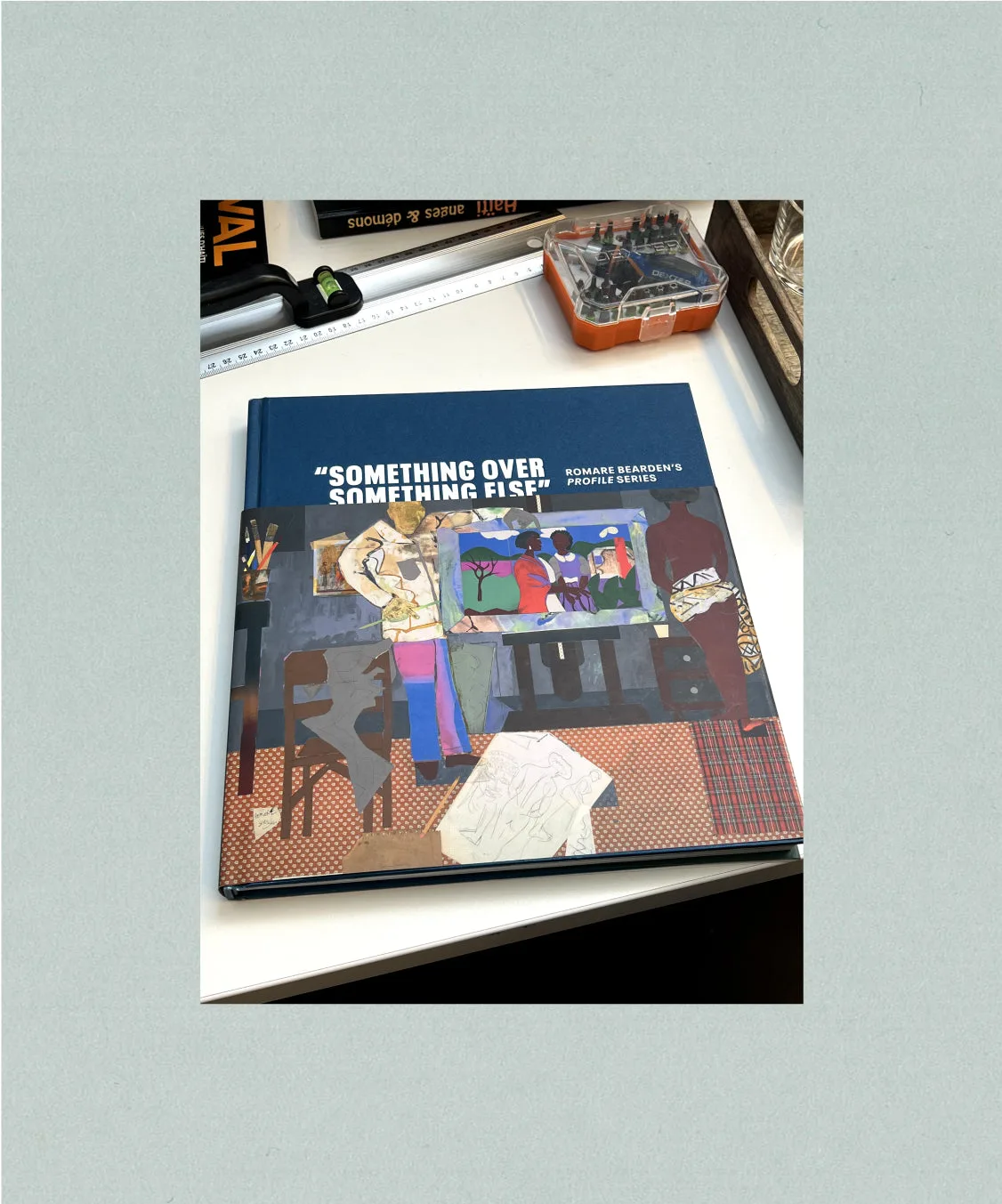
One of his sources of inspiration,
the work of Romare Bearden
JD: Your work will soon be visible at the Palais de Tokyo?
RB: Exactly, this is the big project that has been driving me for several months. The exhibition opens on February 20. It's a mix of existing works and pieces I'm currently creating. What's funny is that I'm at a point in my career where I'm still considered an emerging artist but I'm already being offered retrospective exhibitions. There will be a few pieces from the Pantheon that will be reinstalled, notably textile pieces, but I still have quite a few productions to create.
JD: Are there any in the workshop?
RB: Indeed, these costumes will be on display. We will create some new costumes but there will also be paintings borrowed from private collectors.
JD: A real retrospective... Are there artists who inspire you, whose work you would like to share?
RB: I look at abstract painting a lot, which often surprises people because my work is mostly figurative. I'm thinking of an African-American artist called Sam Gilliam who makes very large textile pieces with completely abstract paint, he plays on the theatricality of the textile, its folds and its presence.
JD: How did you discover it?
RB: I discovered him in the United States because his work is not widely distributed in France. There are collage artists like Romare Bearden or Jacob Lawrence who are almost not known here, but who mean a lot to me because they are precisely in this practice of collage, in publishing. Romare Bearden is an artist that I adore, his work is very poetic. He also looks a lot at the history of painting, there are both photos and things diluted in ink, it's very dreamlike.
Courtesy of the artist
and Mariane Ibrahim Chicago, Paris and Mexico City.